
Managing care staff training is about much more than booking courses. From arranging induction for new starters to monitoring refresher training, keeping certificates organised and identifying gaps in staff knowledge, there is a lot for registered managers to keep on top of.
For many care homes and domiciliary care providers, this means maintaining spreadsheets, sending reminders and repeatedly checking whether employees have completed their training.
But could some of that time be better spent supporting your staff and the people receiving care?
In this guide, we explore how to make care staff training management simpler, reduce unnecessary administration and maintain clear evidence of staff learning and development.
Why is managing care staff training so time-consuming?
Every care provider needs to ensure employees receive the training and support necessary to carry out their responsibilities safely and competently.
Under CQC Regulation 18 (Staffing), care providers must identify staff learning needs, deliver appropriate training and monitor ongoing competence.
However, the administration involved can quickly become complicated, particularly when different employees have different training requirements.
Common challenges include:
- Keeping track of which staff have completed particular subjects.
- Identifying employees who require refresher training.
- Arranging courses around shifts and staffing levels.
- Finding training certificates when they are needed.
- Organising induction for new employees.
- Managing training for staff with different responsibilities.
- Keeping training records accurate when employees join or leave.
None of these tasks is particularly complicated in isolation. The challenge is keeping everything organised as the workforce changes.
What should a care staff training matrix include?
A training matrix provides a central record of the training completed by each member of staff.
A useful matrix should help managers identify:
- Employee details: Who the training record belongs to.
- Required training: Which subjects are relevant to the employee's role.
- Completion dates: When training was undertaken.
- Renewal dates: When refresher training is due, where applicable.
- Training status: Whether learning is completed, in progress, due soon or overdue.
- Certificates: Evidence of completed courses.
- Additional requirements: Training or assessments identified through supervision, risk assessment or changing care needs.
A spreadsheet can achieve some of this, particularly in a smaller organisation. However, it relies on someone keeping the information accurate.
As more employees complete different courses at different times, manually updating a spreadsheet and organising the associated certificates can become increasingly time-consuming.
Seven ways to simplify care staff training management
1. Identify the training each employee needs
Before arranging courses, establish which subjects are relevant to each employee's responsibilities.
Skills for Care provides guidance on statutory and mandatory training, but not every care worker requires precisely the same training.
The requirements of a domiciliary care worker supporting medication administration, for example, may differ from those of another worker with different responsibilities.
Our guide to statutory and mandatory care training explains how to approach these decisions.
2. Keep training records in one place
Having records spread across spreadsheets, emails, folders and different training providers creates unnecessary administration.
Where possible, use a central system to monitor completed training, certificates and outstanding requirements.
This makes it easier to find information when needed and reduces the risk of records becoming inconsistent.
3. Plan refresher training in advance
Waiting until training is overdue can make arranging refresher courses more difficult.
Instead, establish appropriate refresher intervals and regularly review upcoming training requirements.
Different subjects may have different recommendations, and some staff may need additional training sooner because of changes in their responsibilities or the needs of the people they support.
For a detailed explanation, read our 2026 guide to mandatory care training refresher frequencies.
4. Choose training that fits around your rota
Taking employees away from care duties for training can create staffing challenges.
Flexible training arrangements can help reduce disruption.
Self-paced e-learning allows workers to complete suitable knowledge-based training at convenient times, while interactive Live Zoom sessions provide opportunities to ask questions, participate in discussions and learn directly from an experienced trainer.
Using both approaches gives care providers more choice when planning staff development.
Practical workplace assessments and competency checks must still be arranged where required.
5. Make certificates easy to access
Training records and certificates should be easy to locate when managers need to review learning or provide evidence.
Rather than searching through emails or individual folders, a central training record can make this information more accessible.
Remember that certificates demonstrate completion of training, but they do not necessarily replace workplace competency assessments.
6. Make induction part of the same training process
New starters often require several different learning activities during their induction.
The Care Certificate provides a recognised framework for care-worker induction, with 16 standards covering important knowledge, skills and behaviours.
Combining induction planning with ongoing training records helps managers see what has been completed, what still needs assessment and what additional learning is required.
Find out more about Total Training's Care Certificate Induction Programme.
7. Use a training system that reduces administration
Technology can help automate repetitive training administration, including monitoring completion, organising certificates and identifying upcoming renewals.
A training management system should make it easier to see the current position without repeatedly updating spreadsheets.
However, the system is there to support management decisions. Providers remain responsible for determining training requirements, assessing competence and ensuring staff are appropriately prepared for their roles.
How Total Training helps managers stay organised
At Total Training, we've designed our training services around the practical needs of care providers.
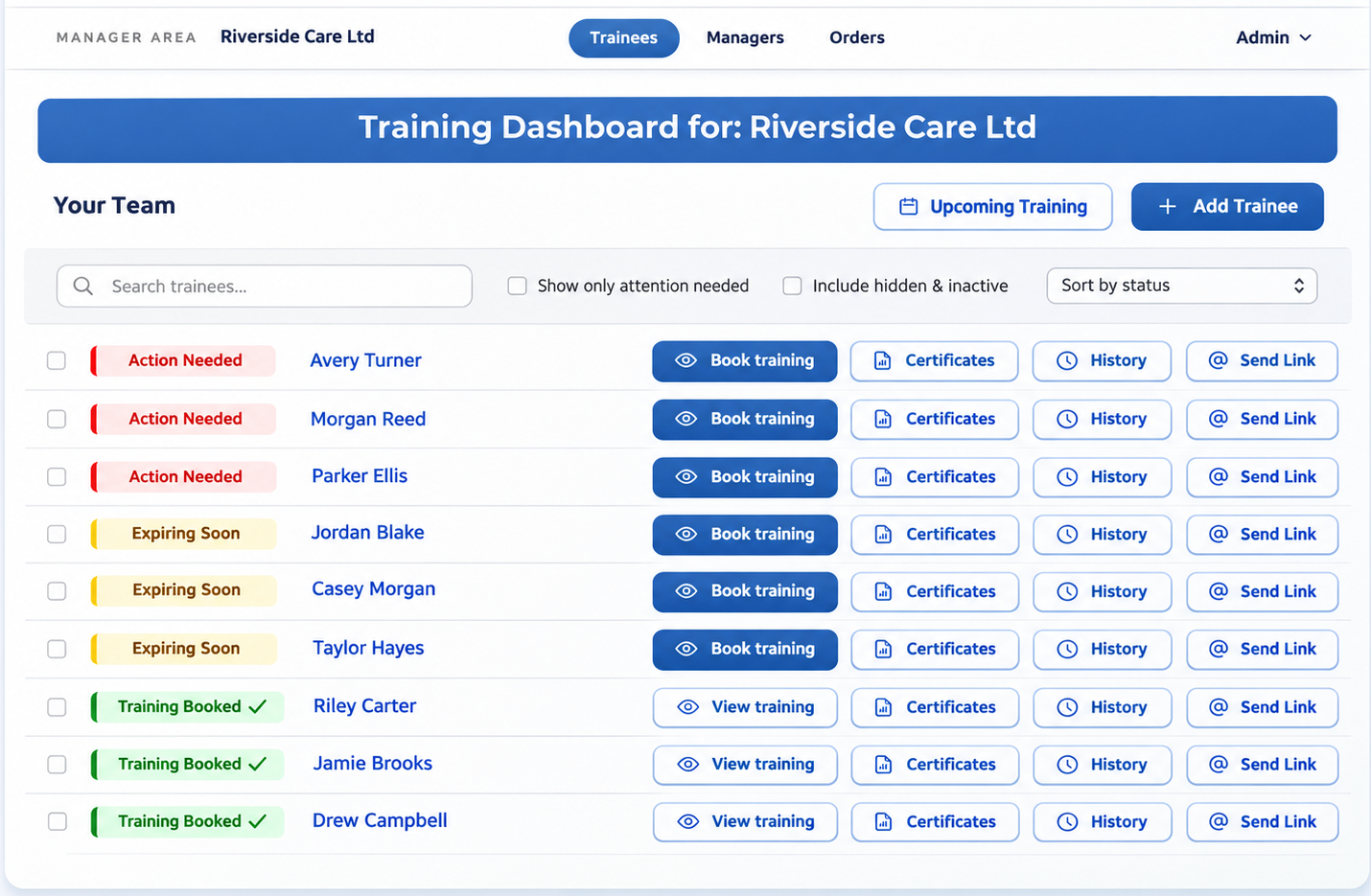
Alongside our 20 core care training subjects, we provide a manager dashboard to help organisations keep their staff training organised.
See staff training progress at a glance
Your dashboard displays the status of training undertaken through Total Training, helping you identify employees who are up to date, in progress, due soon or overdue.
Access training certificates
Completed training certificates can be accessed from the dashboard, reducing the need to search through individual emails or paperwork.
Receive renewal reminders
Training reminders help managers identify when further learning may be required, making it easier to plan ahead.
Book Live Zoom training or assign e-learning
Managers can arrange interactive Live Zoom sessions or give learners access to our in-house e-learning courses.
Our e-learning uses trainer-led video and interactive questions, providing a flexible alternative to scheduled sessions.
Choose how you purchase training
Care providers can purchase individual courses, training bundles or annual subscriptions.
Subscriptions are particularly useful for organisations with ongoing training requirements, regular new starters or several employees needing training throughout the year.
Is a training subscription better than buying individual courses?
That depends on how frequently your organisation needs training.
If you only need to arrange an occasional course, individual purchases or a one-off bundle may be appropriate.
If you regularly induct new employees, arrange refresher courses or train multiple staff members, a subscription may offer better value and make training budgets easier to plan.
Total Training offers both e-learning-only subscriptions and combined Live Zoom and e-learning subscriptions, with different learner allowances to suit the size of your organisation.
You can compare our care training subscriptions to see which option best suits your team.
Spend less time on administration and more time supporting your team
Effective staff training requires more than completing courses and collecting certificates.
Managers need to identify learning needs, support competence, maintain accurate records and ensure employees receive appropriate ongoing development.
The right training system can make that process easier by reducing repetitive administration and giving managers clearer information.
At Total Training, our aim is to make delivering and organising care training as straightforward as possible.
Want to see how it works?
Explore how Total Training works, including our training options and manager dashboard.
Alternatively, call our friendly team on 01494 771935 to discuss how we can help simplify training for your care service.